
Electrical Storm
When the Dam Broke

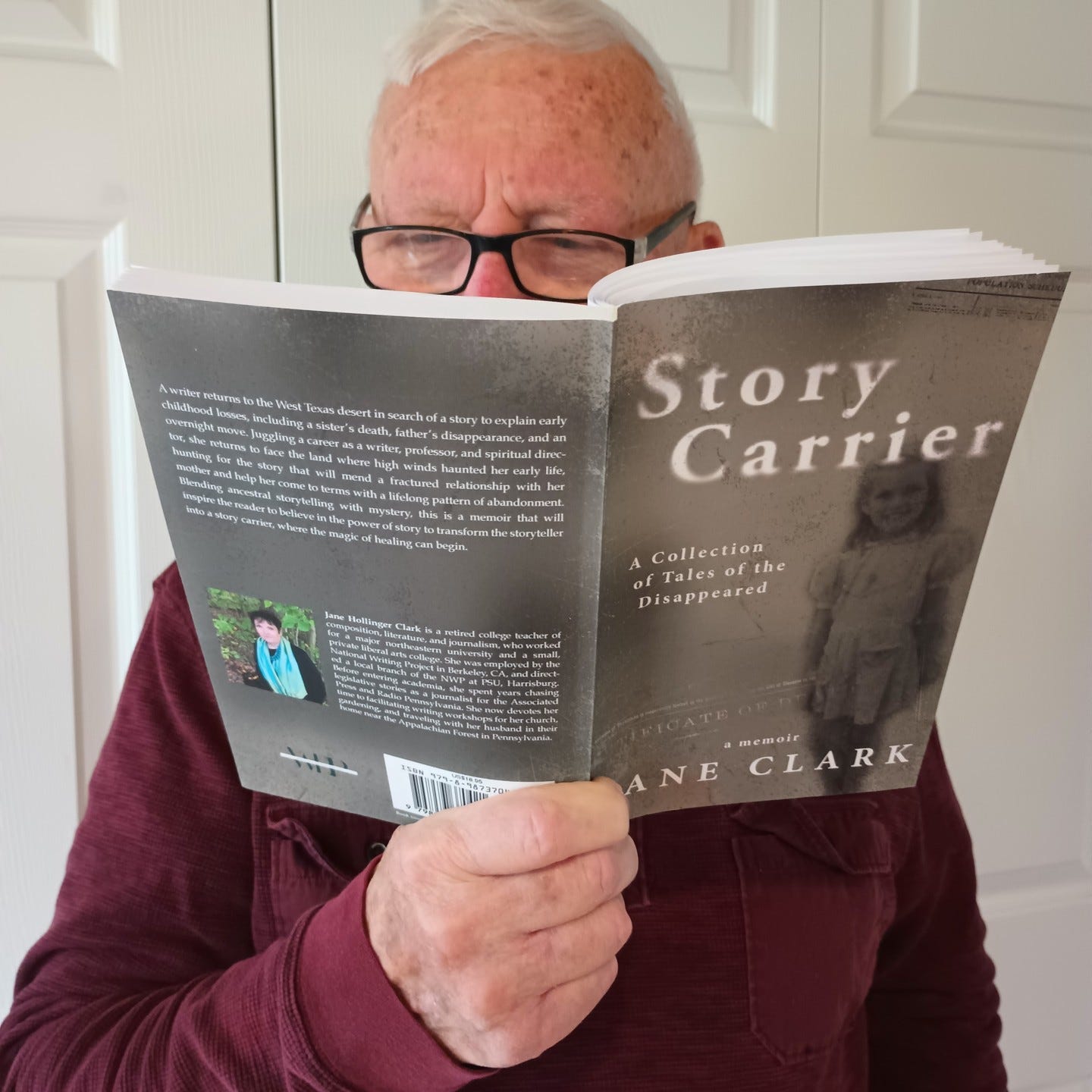
My husband, reading my memoir in healthier times
The sky broke apart like the wall of a dam collapsing beneath the weight of a swollen river it once held back. Rain fell in angry sheets, stinging my back as I ran down the front steps of my porch and across the street to my neighbor’s waiting car. We sat together until the ambulance and rescue truck pulled out, then followed behind them to the hospital.
“It’s good to be behind them,” Jean explained. “That way, if his condition gets worse, you’ll see them pull over.”
Her words didn’t rattle me. I was already beginning to numb myself to what the sky seemed to warn was coming. Within minutes, we were inside the emergency room, soaked, stepping into a different world — stale air, beeping monitors, staff rushing through the hallways.
Inside my husband’s room, we watched the nurse insert IVs and begin to take vital signs. She set up a large monitor that projected his blood pressure, heart rate, and pulse oxygen levels. The numbers weren’t good. His heart rate registered at 28.
I didn’t know what that meant until the cardiologist arrived.
“Third-degree AV heart block,” he said flatly.
“What does that mean?” I asked.
“I’m assuming the pacemaker we installed a few days ago has become dislodged. It’s not working.”
I gasped. “What in God’s name does that mean?”
He bent his neatly coiffed head to listen to my husband’s chest. “It’s a simple fix,” he said. I searched his face for a sign that he’d stabilize. For assurance that what had broken could be repaired. Outside, the storm raged on. Inside me, another storm brewed. I’ve always trusted my intuition, nature — the wind, the sky, more than I’ve ever trusted machines.
“Okay,” I lied, as pressure built in my own chest. A storm of a different kind. A river of trauma.
Within an hour, my husband’s heart rate climbed — and then dropped precipitously. 74… 52… 34… 28.
His nurse stepped closer and asked how he felt. “Dizzy,” he said. “Weak.”
His daughter stroked his arm. “You’re doing fine, Dad.”
“He needs to see the cardiologist again,” I said. The nurse left the room. Then, she returned alone. His condition worsened.
“I can’t see,” he said. I leaned closer, hoping he’d be comforted by my touch.
The water, in my mind, was pressing against the dam. Pressure mounting. Something was about to give. I felt the oncoming catastrophe, but I felt helpless.
“Where is the doctor?” I asked. “What about the doctor?”
I looked at his daughter, who held his hand. A river of tears was building behind her eyes. I wanted to scream for the suffering I could see in her face. I wanted someone to do something.
No one came. Not for hours.
I begged. I called out. A hospitalist entered, said, “I’ll touch base with cardiology,” and left. That phrase — touch base — didn’t feel like care. It felt like a slap.
For over five hours, his heart stopped and restarted. His vision disappeared. His hearing faded. He begged for help. I begged for help. His daughter and I stood watch over the man we both adored, trying to steel ourselves for what we feared most: that he might be lost in the devastation that was taking place within the walls of the hospital. That his life would be swept away in the collapse of an institution’s neglect.

In that desperate space, I did what I thought I had to do: I began holding up the sky for my husband. I forgot that it wasn’t my job. I stepped into the role of caregiver because no one else was doing it. People came and went. They took blood. They told him to “breathe deeply.” But nothing changed.
This was his second visit in five days for a routine pacemaker installation. And yet, no one could — or would — get a cardiologist into the room to repair the damage that was causing him to suffer.
Days later, after his discharge, I’d read the summary notes, which said he was diagnosed with third-degree heart block--a deadly diagnosis. The note also said he was asymptomatic.”
He was not.
As the hours moved on, death hovered in the room while the storm raged outside. I felt like the little boy in the nursery rhyme, who plunged his finger into the dam, trying with all his might to prevent the flood from coming.
What we couldn’t see was the institutional system, dressed in scrubs and protocol, swelling with its own incompetence. I was too afraid of losing him to notice the dam crumbling right in front of me. But what I did realize was something devastating: that inside this hospital, my husband was not a human being. He was a name on a chart. A minor figure in a process built not to save lives, but to sustain itself.
Most of us don’t know our rights as patients or caregivers. We don’t know we’re allowed to demand life-saving care. And when we try, we risk being labeled aggressive or irrational. But let me be clear: no one should have to beg for medical care.
The illusion of care: The badges, the white coats, the sterile language. This is not care. It’s performance. Inside this hospital, care was something else: it was behavior, based on policies and procedures, intended to protect the institution.
Finally, in desperation, I texted my sister, a retired cardiac nurse and nursing professor. I described his symptoms. She responded immediately: “He’s in a dangerous zone. Go demand help now. Demand a cardiologist or threaten to have him transferred to another hospital.”
When I did, the ER doctor burst into the room: “She’s here. The cardiologist is reading his chart now. She’ll be in shortly.”
Finally, she came. After five hours in which he struggled to stay alive.
Within forty-five minutes, he was taken into surgery to insert a temporary pacemaker to keep him alive until surgeons could repair the lead on the permanent pacemaker that had dislodged. The device that had failed.
The next night, while doctors worked on his heart, I paced the floor outside the operating room, praying that he’d make it. My phone flashed with emergency alerts warning residents in the area of flooding caused by the ongoing storms that continued throughout the night. Two hours later, the surgeon burst through the doors to tell us he’d survived. My husband’s daughter and I finally allowed ourselves to cry. We let the walls of our hearts crumble under the weight of fear we’d been carrying for days. The surgeon seemed to be sure of himself, especially when he told us the failure was caused by my husband’s large heart. But I didn’t feel relief. I felt wrecked. Shaking. Crying. My husband had worked in that very hospital for years as a security guard. He walked the halls, protecting the people who had now left him to suffer. And I? I held up the sky while the dam collapsed.
This was not a freak occurrence. This was not the river swelling too fast. This was a design failure. A system not built for care, but for risk containment.
The dam is a myth of safety. It’s the lie we’re told: that hospitals protect, that doctors heal, that systems are designed for patients. But when the system breaks, no one answers for the lives it sweeps away.

In our case, it wasn’t the storm that betrayed us. It was the people who built the dam who told us we were safe. And now we live in the valley, surrounded by debris. Trauma. Terror. Fear. The danger was never his anatomy or the weather. The danger was the system. The training. The communication breakdowns. The passive neglect.
After he was taken to a room in the Intensive Care Unit, I walked out of that hospital at two in the morning with post-hospitalization traumatic stress, medical betrayal, moral injury in caregiving, and coerced complicity in care failure. I still have nightmares of the look on his face as he lay near death in the Emergency Room—the look of terror caused by abandonment; a form of indirect violence caused by not being seen by those in charge of his care.
I was carrying a wound deeper than any surgical scar.
My husband is home now. But, he’s not the same man he was. He’s afraid to sleep. Afraid to return to himself as a father, grandfather, husband. The procedure saved his heart. But it stole his safety. And in that way, the system did not heal him.
It broke him. And it shattered my heart.
Weeks later, a cardiologist called — one of the many voices of the system still circling back, asking questions that sounded like concern but landed like interrogation.
He asked what they could do for us, what I needed, what would make this better. And I told him.
“Each time someone from your system calls with questions or asks me to explain what happened, or asks what you can do for me, and you offer nothing, I am re-traumatized. I feel like you are coercing me into lowering my expectations for good health care and real, solid follow-up.”
He was silent for a moment. Startled, I think, because I had broken the spell, the pattern of compliance. I hadn’t raised my voice. I had simply told the truth.
What I didn’t say was that every phone call from their “care team” felt like a rehearsal in learned helplessness, an invitation to be grateful that my husband survived at all. They didn’t want accountability. They wanted our forgiveness. But they didn’t want to ask for it.
In the quiet after the storm, I finally understood. The danger was never the weather, or even the failing heart that set this all in motion. The danger was the dam. The man-made structure called healthcare, built from policies, profits, and polite reassurance, not compassion. The danger was the arrogance that believed it could hold back the current of human suffering and call it “standard care.”
And yet, in the wreckage, I found something fierce: my voice. I am no longer waiting for the system to heal me, or to explain itself. The storm has passed, but I will keep the sound of its thunder as proof that I was here. I was awake, unafraid, and uncoerced.
Beautifully written. We all must learn the skill of advocacy in most healthcare settings. Especially in emergency situations where a loved one hovers near death. I am reminded of the powerful acting by Shirley MacLaine in Terms of Endearment (a film adapted from Larry McMurtry’s work) where she stands and hovers and paces at the nurse’s station. She is mostly ignored until she raises her voice decibels above hospital protocol and screams, “Give my daughter her shot…” I am always prepared to bring forth the Shirley in me when faced with inadequate and delayed responses from the broken healthcare system. Blessings on you.
Oh my goodness how terrifying. And so powerfully written. I’m so sorry.