
Voices from the Threshold
Why Now is the Time to Write Women's Stories

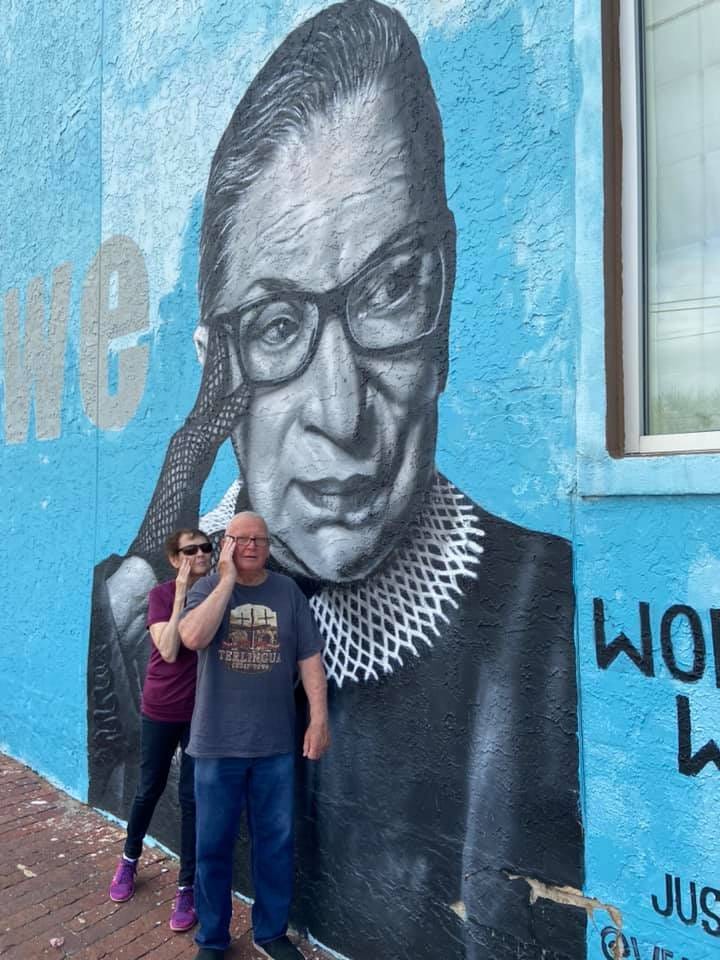
The hand of a woman who once changed the law now calls us to change the story.
We stood in the shadow of an oversized mural of Ruth Bader Ginsburg painted on an abandoned building in downtown San Antonio, the air heavy with summer humidity, posing like tourists trying to make a statement. My brother took the photo, and we quickly jumped back into the air conditioning of his car, heading off in search of other artworks scattered around the city.
At the time, I thought the photo was clever. The two of us, mirroring the Judge’s pose. But something lingered after we drove away. She had left the world two years earlier, yet her painted image felt alive. It was as though she were reaching out beyond me to other women carrying untold stories. Her raised hand, resting against her face, felt like the gesture of a wise elder, issuing a call, a silent urging for women everywhere to speak what history has tried to silence.
So much has changed since her death. We are now living in the shadow of a regime that not only continues to destroy the rights of women and other marginalized groups but also threatens our most fundamental power: the right to our own stories. They are being rewritten, reduced, and, in many cases, erased by laws, systems, and cultural narratives that determine which voices are heard — and which are not.
That is why writing our stories in our own voices matters so deeply. It is why writing has become more than a craft. More than expressive practice, it is a form of reclamation.
Recently, ten women stood on the steps of the U.S. Capitol and spoke the unspeakable. Survivors of Jeffrey Epstein’s abuse gathered at the threshold of power to demand the release of the names of those who have been implicated as perpetrators. Story by story, each woman added to the record until their collective voice cracked open something larger than the files they demanded: it ruptured the silence that has long protected the guilty. Theirs was a ritualized act of reclaiming narrative control, reminding us that telling the story is more than catharsis; it is an act of justice.
Every woman who writes reclaims authorship over her own life. Much like these women, she refuses to be reduced to a rumor, role, or statistic. By resisting attempts to define her through stories written about her victimization, she takes on the role of a truth-teller that no institution can silence.
The Lineage of Restored Voice
The patriarchy has always been threatened by a woman who knows and a woman who dares to speak.
Even before written history, women stood at the threshold between silence and truth.
Cassandra, the prophet of Troy, earned her title in a twisted way when she refused the romantic advances of the god Apollo. She also turned down his gift of prophecy, and in response, he turned the blessing into a curse: “You will always tell the truth, but no one will ever believe you.” (Aeschylus. Agamemnon. Translated by Robert Fagles, Penguin Classics, 1979.)
Cassandra’s story became the first warning of what happens when women’s voices are dismissed. Her fate is an ancient mirror of what is still occurring in our time. She’s a symbol of the woman who sees clearly but is not believed, and her story carries deep resonance with the fears that burden women today: the cost of knowing and the pain of disbelief.
Centuries later, Hypatia of Alexandria stepped into the public square to teach philosophy and mathematics to political leaders, despite the danger of doing so. She taught Neoplatonism, the philosophy that emphasized the pursuit of truth through reason and dialogue. At the time, the city was divided between Christian, pagan, and Jewish factions, and her voice in a public forum made her a threat to the hierarchy that centered men, especially clergy, who were the carriers of divine knowledge. She was particularly feared by Cyril, the Patriarch of Alexandria, who saw her as a threat to his authority. While walking home from a lecture, Hypatia was grabbed by a mob of Christian zealots — reportedly followers of Cyril — and dragged to a church, where she was stripped and murdered. (Dzielska, Maria. Hypatia of Alexandria. Harvard University Press, 1995.)
Her death sent a chilling message: there will be no authority outside the Church, and no woman may stand as its equal. Her murder was meant to bury her message that truth belongs to all who seek it, not just those who wield power. Even today, her call echoes, “Reserve your right to think.”
Centuries later, Audre Lorde named the same danger in another form. She told us that our silence will never protect us, because it only serves the structures that depend on our compliance. What began as the Church’s fear of a woman’s mind has transformed into the culture’s fear of a woman’s truth. The threat that killed Hypatia has never disappeared; it surfaces whenever a woman is dismissed for being “too emotional,” “too angry,” “too educated,” “too much.” It lives in every system that rewards silence and punishes speech, and we see the response in the public humiliation and demonizing of women who dare to do so.
Speaking, whether through writing, teaching, or naming injustice, is a form of resistance. Each word is a refusal to let that ancient fear define what constitutes knowledge, or who is allowed to survive. Audre Lorde called this “the transformation of silence into language and action.” She knew that voice was not a luxury but a necessity for survival. Every time we speak, we are supported by the spirit of her essays and poems, which tore open the myth that silence keeps us safe. And her words still rise in our collective conscience. “Your silence will not protect you.” (Lorde, Audre. “The Transformation of Silence into Language and Action.” Sister Outsider: Essays and Speeches, Crossing Press, 1984.)
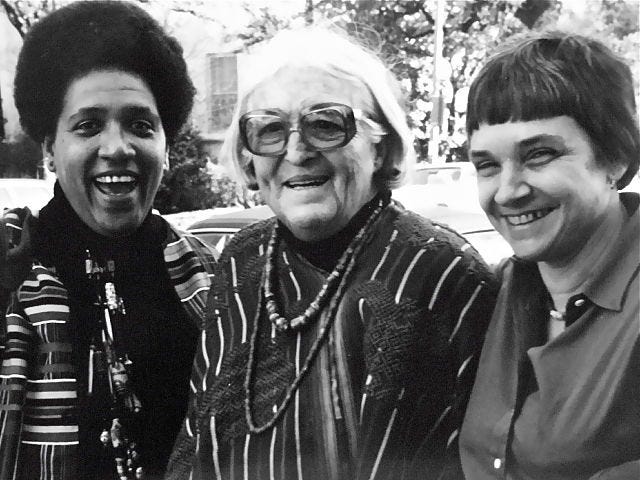
Audre Lorde, Meridel Lesueur, Adrienne Rich 1980 (820298895).jpg
.jpg)
Unsilencing is more than an act of personal, individual freedom. This was the message of Patricia P. Johnson, as she stood on the frontlines of the Stonewall Crossing in 1969, a defining moment in the early gay liberation and transgender rights movements. Johnson’s words rang out, insisting, “No pride for some of us without liberation for all of us,” and set the bar for what unsilencing must become. (Carter, David. Stonewall: The Riots That Sparked the Gay Revolution. St. Martin’s Press, 2004.)
Too often, white women have mistaken personal empowerment for collective freedom, believing that the privilege of speech for us was the dismantling of silence for all. But silence is not only the absence of voice; it is the refusal to name how systems of power work through us, protecting some while destroying others. This is one of the most dangerous elements of oppression that gets very little attention, and I want to stress how important it is to understand.
To speak now is not only to reclaim our voice, but to dismantle the lie that silence ever kept us safe. Let me be clear: This is a harmful lie. We must recognize that our comfort has been built upon the erasure of others and that our liberation is bound to theirs. Unsilencing, then, cannot end with confession or storytelling alone. It must widen its scope to include listening across difference. In speaking, we must acknowledge complicity. Like Cassandra, we must refuse to believe that being centered makes us safe. Otherwise, we risk recreating the very hierarchies we claim to resist.
This is the new threshold: to use voice not as a symbol of individual freedom but as an act of solidarity. An offering toward collective liberation.
This does not come with the promise of safety. There is risk in stepping out of silence, but there is also reward. Journalist and activist, Ida B. Wells, wrote her truth in the face of danger, documenting lynching when white newspapers refused. “The way to right wrongs,” she said, “is to turn the light of truth upon them.” Her words were more than reporting. They were acts of resistance. (Wells-Barnett, Ida B. Southern Horrors: Lynch Law in All Its Phases. The New York Age Print, 1892.)
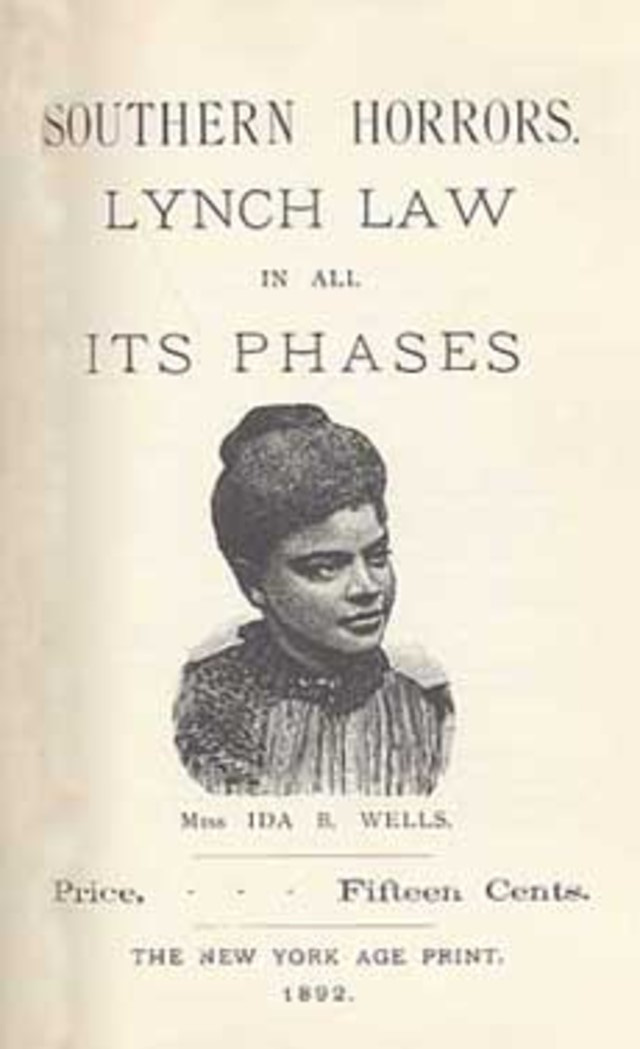
Ida B. Wells (author), Southern Horrors: Lynch Law in All Its Phases, 1892.
History is filled with the stories of women who have given us a map for crossing the threshold. One has even explained what to expect when we stand at the edge of fear and wait for the story to first awaken.
Gloria Anzaldúa, the Chicana theorist and poet, born in the Texas borderlands to a Mexican and Indigenous family, called this zone between silence and voice Nepantla: a place of transformation, where pain becomes power and identity expands beyond categories. “I write,” she said, “because I’m afraid of writing, but I’m more afraid of not writing.” (Anzaldúa, Gloria. Borderlands/La Frontera: The New Mestiza. Aunt Lute Books, 1987.) Like Lorde, Anzaldua turned fear itself into a creative threshold.
Tarana Burke, founder of the #MeToo movement, who was inspired by the suffering of a young girl who had been assaulted, whispered the phrase that became a drumbeat that went viral. (Burke, Tarana. “Me Too.” Just Be Inc., 2006, www.justbeinc.org.) Decades later, when millions of women responded, they crossed the threshold she opened, finding in collective testimony the beginning of healing and the possibility of justice.
And still, beyond the spotlight, unnamed women have done this work quietly. The grandmothers who whispered forbidden stories, the daughters who dared to write their mothers’ names into the margins of history, the everyday women who keep journals no one has read. They, too, deserve to be heard. These unknown women are keepers of memory, and their stories live inside ours, humming in our bones. Whether we know it or not, we carry their stories across the centuries, passing them along from one generation to the next. They are the carriers of our collective truth.
I keep thinking back to that day in San Antonio. The heat, the worn paint, the shadow of Justice Ginsburg stretching across the wall. At the time, it felt like a photograph. Now, it feels like a message. Her gaze still follows me, the way a story does when it’s unfinished. I can feel her voice reaching across the threshold of centuries, calling to every woman who has ever carried a silenced story: “Speak.”
Perhaps that is the pull I felt that day, the recognition that the fight for equality, for voice, for truth, is never past tense. It is a living inheritance. And each time we write, we step into that shadow of history, not to be diminished by it but to extend its light. To write is to join them. To tell our stories is to extend the work they began.
If you’ve been waiting for the “right time” to begin, this is it.
Choose one moment, one memory, one silence that still tugs at you—and write it. Step up to the border that leads you from silence into story. Don’t wait for permission. Your story is the permission.
This is the heart of my new book, Storying Silence: A Guide to Restoring Voice, Reclaiming Autonomy, and Sovereignty.
It’s more than a book—it’s a call to begin. I’d be honored if you’d order a copy at
Note on Sources and Lineage
This essay stands on the shoulders of women who refused silence, across centuries, languages, and thresholds. Their words have carried truth through exile, punishment, and transformation, forming a lineage of resistance that still calls us to speak.
The voices gathered here compose a living archive of unsilencing.
Readers who wish to go deeper into this legacy will find that each of these writers offers a threshold of her own: an invitation to write, read, and live with greater clarity, courage, and compassion.
Aeschylus. Agamemnon. Translated by Robert Fagles, Penguin Classics, 1979.
Anzaldúa, Gloria. Borderlands/La Frontera: The New Mestiza. 4th ed., edited by Ana Louise Keating, Aunt Lute Books, 2012.
Apollodorus. The Library. Translated by Sir James George Frazer, Harvard University Press, 1921.
Burke, Tarana. Unbound: My Story of Liberation and the Birth of the MeToo Movement. Flatiron Books, 2021.
—. “Me Too Is a Movement, Not a Moment.” TEDWomen, Dec. 2018, www.ted.com/talks/tarana_burke_me_too_is_a_movement_not_a_moment.
Dzielska, Maria. Hypatia of Alexandria. Harvard University Press, 1995.
Lorde, Audre. “The Transformation of Silence into Language and Action.” Sister Outsider: Essays and Speeches, Crossing Press, 1984, pp. 40–44.
Socrates Scholasticus. The Ecclesiastical History of Socrates Scholasticus. Translated by A. C. Zenos, in A Select Library of Nicene and Post-Nicene Fathers of the Christian Church, edited by Philip Schaff and Henry Wace, vol. 2, Christian Literature Publishing Co., 1890.
Wells-Barnett, Ida B. Southern Horrors: Lynch Law in All Its Phases. The New York Age Print, 1892.
Superb!
I love this powerful piece!! The mural of Ginsberg is evocative and her gaze is intense. It has triggered in me a story needing to be told about my paternal grandmother whose silence caused her throat cancer of the larynx. Her eldest son my father, witnessed her “stoic silence.” Lydia was her name and I was named after her- my full name is Mary Lydia. Interesting how my father was my main supporter in my family of my feminism and developing my mind and voice. He saw in me what he knew his own mother could not say or embody. Thank you for your writing and your voice that pierced a veil for me this early morning♥️